

The California Court of Appeal, Fourth Appellate District, recently held that a group of senior citizen consumers were required to pursue administrative remedies before suing private companies to challenge their tax assessments billed under the state's Property Assessed Clean Energy program (PACE).

The U.S. Court of Appeals for the Seventh Circuit affirmed a trial court’s dismissal, on separate grounds, of a borrower’s FCRA claims because the borrower lacked standing. In addition, the Seventh Circuit held that the borrower’s affidavit made conclusory statements with documentary support and was therefore insufficient to defeat the lender’s motion for summary judgment.

The U.S. Court of Appeals for the Seventh Circuit recently affirmed a trial court's ruling that a credit union’s fee practices did not breach its contract with a customer. In so ruling, the Seventh Circuit held that the credit union did not make any promises not to use the "available balance" method to assess nonsufficient fund (NSF) fees or not to charge multiple fees when a transaction is presented to it multiple times.

A group is pushing Arizona Proposition 209, a ballot measure they say will reduce the burden of “medical debt.” But while a small portion of Proposition 209 might relieve some of the burden of medical debt, other beneficiaries are swindlers and bad actors.

The California Court of Appeal for the First Appellate District recently reversed a trial court's decision to affirm an arbitration award that upheld the validity of a late payment fee assessed to borrowers in the event of a borrower's default.

In response to a certified question from a bankruptcy court, the Arizona Supreme Court held that a recorded judgment lien attaches to homestead property where the judgment debtor has equity in excess of the $150,000 exemption under Arizona law.
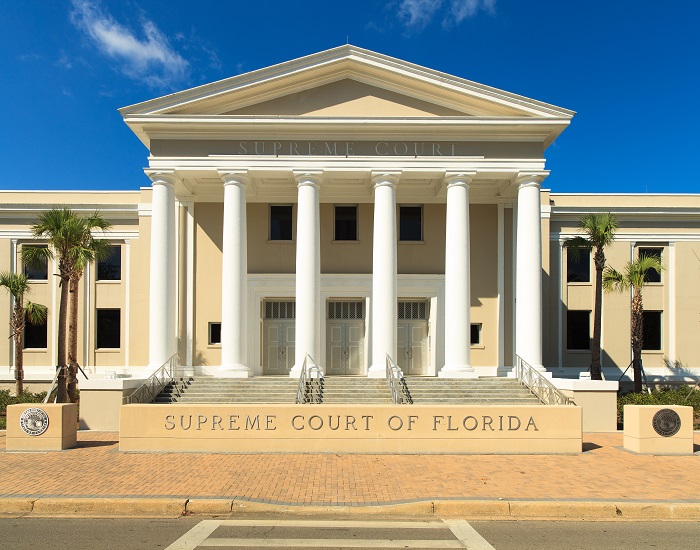
The U.S. Court of Appeals for the Eleventh Circuit recently held that a bank did not perfect its security interest in a business debtor’s assets because the two UCC-1 Financing Statements filed with the Florida Secured Transaction Registry that failed to correctly name the debtor were “seriously misleading” under Florida Statute Section 679.5061(2), as the Registry does not implement a “standard search logic” necessary to trigger the safe harbor exception set forth in Florida Statute Section 679.5061(3).

The U.S. Court of Appeals for the Fifth Circuit on Oct. 19 held that the federal Consumer Financial Protection Bureau’s Payday Lending Rule was invalid because it was promulgated using an unconstitutional funding scheme.

The U.S. Court of Appeals for the Third Circuit recently held in Clemens v. ExecuPharm Inc. that the risk of future harm from a data breach can be enough for Article III standing, taking into consideration whether the breach was intentional, whether the data was misused, and the nature of the data accessed.

The U.S. Court of Appeals for the Sixth Circuit recently affirmed the dismissal of a lender’s RICO claims asserted in connection with a borrower’s default on a $5 million loan.

On Sept. 27, Michigan Sen. Rosemary Bayer and eight fellow Democrat cosponsors introduced Senate Bill 1182, which would create the Michigan Personal Data Privacy Act. The Michigan Legislature remains in session through the end of the year.

The U.S. Court of Appeals for the Second Circuit recently held that: (1) New York’s interest-on-escrow law is preempted by the National Bank Act of 1864 under the “ordinary legal principles of pre-emption,” Barnett Bank of Marion Cnty., N.A. v. Nelson, and (2) the amendments to the NBA in the Dodd Frank Wall Street Reform and Consumer Protection Act did not change this analysis.